
SUSTAINABILITY OFFICE
Joint Cross-border Destination Management Strategy developed as part of international GUSTI project
Sustainability Office provided expert support in developing the Cross-Border Destination Management Strategy, combining destination research, stakeholder engagement, and strategic planning to support the sustainable development of gastro-tourism in the cross-border area of Croatia and Italy.
GUSTI – Cross-Border Strategy for Sustainable Gastro-tourism
As part of the international GUSTI project (Gastro UpScaled Tourist Itinerary in rural regions of Croatia and Italy), Sustainability Office provided expert support in the development of a Cross-Border Destination Management Strategy, designed to guide the joint planning and development of sustainable gastro-tourism across the participating Croatian and Italian territories.
With a total budget of €2.6 million, the GUSTI project was co-funded through the Interreg VI-A Italy–Croatia 2021–2027 Programme. The project focused on developing an innovative model of sustainable tourism based on local food, short supply chains, traditional gastronomy and rich gastro-cultural heritage, with the aim of creating tourism opportunities that benefit local communities while preserving the resources and identity on which destinations depend. At the heart of the project was the ambition to transform traditional cuisine and intangible cultural heritage of rural areas into attractive, contemporary and year-round tourism experiences. At the same time, GUSTI aimed to contribute to reducing food waste, strengthening local agricultural producers and small businesses, and creating stronger connections between local resources, communities and tourism development.
The Cross-border Strategy provides a common basis for addressing key questions around the future development of gastronomic tourism: What are the distinctive resources and competitive advantages of the participating destinations? What are their main development needs and opportunities? And how can tourism be developed in a way that creates long-term value for local communities while safeguarding cultural and natural resources?
The Strategy defines a shared vision, strategic objectives and development priorities for the cross-border Adriatic area, with a particular focus on the preservation and valorisation of intangible cultural heritage, strengthening local value chains, and promoting sustainable tourism practices and solutions. Its purpose is to provide a practical strategic basis for the development of tourism products and experiences that support destination sustainability and generate benefits for local stakeholders without compromising the resources that underpin tourism in the first place.
Sustainability Office’s role
Sustainability Office contributed to the development of the Strategy through an integrated research, stakeholder engagement and strategic planning process. Our work included:
developing the methodological approach for assessing the strategic position of destinations, prioritising development needs and formulating the overall strategic framework;
conducting destination research and analysis, including an assessment of current conditions, trends and development opportunities;
mapping local resources, with a particular focus on gastronomic, cultural and intangible heritage;
identifying key development needs, challenges and potential of the participating destinations;
engaging local and regional stakeholders to gather knowledge and perspectives, validate findings and build ownership of the strategic directions;
developing strategic approaches for visitor attraction and sustainable destination management;
defining guidelines for the preservation, interpretation and valorisation of cultural and gastronomic heritage;
translating research and stakeholder insights into a comprehensive Cross-Border Destination Management Strategy for the participating areas in Croatia and Italy.
The resulting Strategy brings together an overview of key gastronomic tourism trends and characteristics, an analysis of the current situation across the GUSTI area, an assessment of development needs and opportunities, and a shared vision for the future. It further defines strategic objectives and priority development measures, supported by performance indicators and medium- and long-term targets.
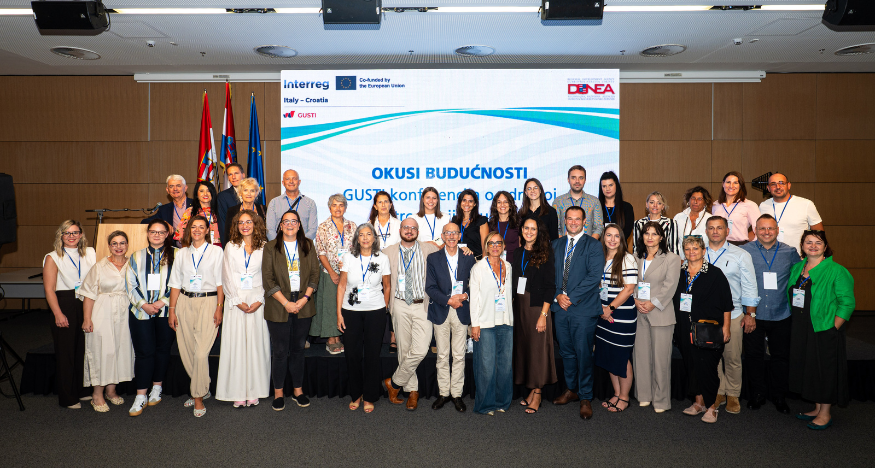
The Strategy was presented at the GUSTI project’s final conference, “Flavours of the Future: GUSTI Conference on Sustainable Gastronomy and Tourism,” held in Dubrovnik on 16 September 2026.
A key message was that sustainable tourism is not simply about increasing visitor numbers. It is about developing tourism that is more responsible, more deeply rooted in local places, and more beneficial to the people and communities that sustain it. The GUSTI vision is built around the development of a distinctive cross-border gastronomic and cultural destination, where visitors can discover authentic local food, traditions and heritage, while local stakeholders work together to shape and manage tourism development. Four principles underpin this approach: sustainability, participation, authenticity and competitiveness.
Power in Numbers
30
Strategic gao
50
Locations
200
Volunteers
Gallery


